
Empowering Digital Safety.
Supporting Mental Well-Being.
I am an independent advocate dedicated to sharing essential digital hygiene practices, raising awareness about cybercrimes like sextortion, and connecting you to professional lifelines when you need them most.
Understanding Sextortion: Take Back Control
If you are being blackmailed with intimate images, understand this: you are the victim of a coordinated criminal attack. The criminals rely on your panic and shame to control you.
Breathe. Follow these steps.
Links and Resources for the Website
- https://justiceforbryce.com/
- https://www.missingkids.org/home
- https://stopncii.org/
- takeitdown.ncmec.org
- https://www.netsmartzkids.org/
- https://www.stopsextortion.com/
- https://988lifeline.org/
- https://www.missingkids.org/gethelpnow/cybertipline
- https://www.fbi.gov/sextortion
- https://blog.tcea.org/tag/digital-safety/
- https://www.johnjermain.org/wp-content/uploads/2025/06/613c4b05-a12e-4791-8ce5-69b3cf61e75f.png
- https://www.outrightcrm.com/wp-content/uploads/2025/08/online-safety-stay-smart-secure-online.jpg
- https://digital.va.gov/cyber-spot/social-media-the-safe-way/
- https://www.iwf.org.uk/resources/sextortion/adults/
- https://www.iasp.info/suicidalthoughts/
- https://www.media.mit.edu/projects/detect-fakes/overview/
- Nearly half (44%) of sextortion victims indicated the imagery that was used to extort them was acquired through a recording or screenshot without their consent.
- Catfishing was a concept many respondents were familiar with, with half (53%) of all young people surveyed believing someone online had used a fake or misleading persona (like a fake profile or lying about their identity) to trick them into connecting or interacting with them, including half (50%) of teens.
- Alarmingly, 1 in 6 (17%) young people reported they were first sextorted while aged 12 or younger.
- In 2024, the National Center for Missing and Exploited Children (NCMEC) received approximately 100 reports of financial sexual extortion (sextortion) each day.
- Only 17% of youth and 11% of parents could name a specific authority, e.g. police, FBI, the CyberTipline, and internet service providers, to which they could report an internet crime.
Reporting Resources
- Local Police Department: For immediate danger or physical threats, advising victims to call 911 is paramount.
- FBI (USA): Report the incident to your local FBI field office, call 1-800-CALL-FBI (225-5324)
- FBI Internet Crime Complaint Center (IC3): The central hub for reporting all internet-facilitated crimes. Victims should file a report online at www.ic3.gov.
- Cyber Civil Rights Initiative (CCRI): Call the Crisis Helpline at 844-878-CCRI (2274
- National Sexual Assault Hotline (RAINN): Call 1-800-656-HOPE (4673) or chat online for free, confidential support 24/7.
- Thorn (Stop Sextortion): Text “THORN” to 741741 to chat anonymously with a trained Crisis Text Line counselor.
- Crisis Text Line: A free, 24/7 text-based support line. Text “HOME” to 741741 or “4HOPE” to 741741.
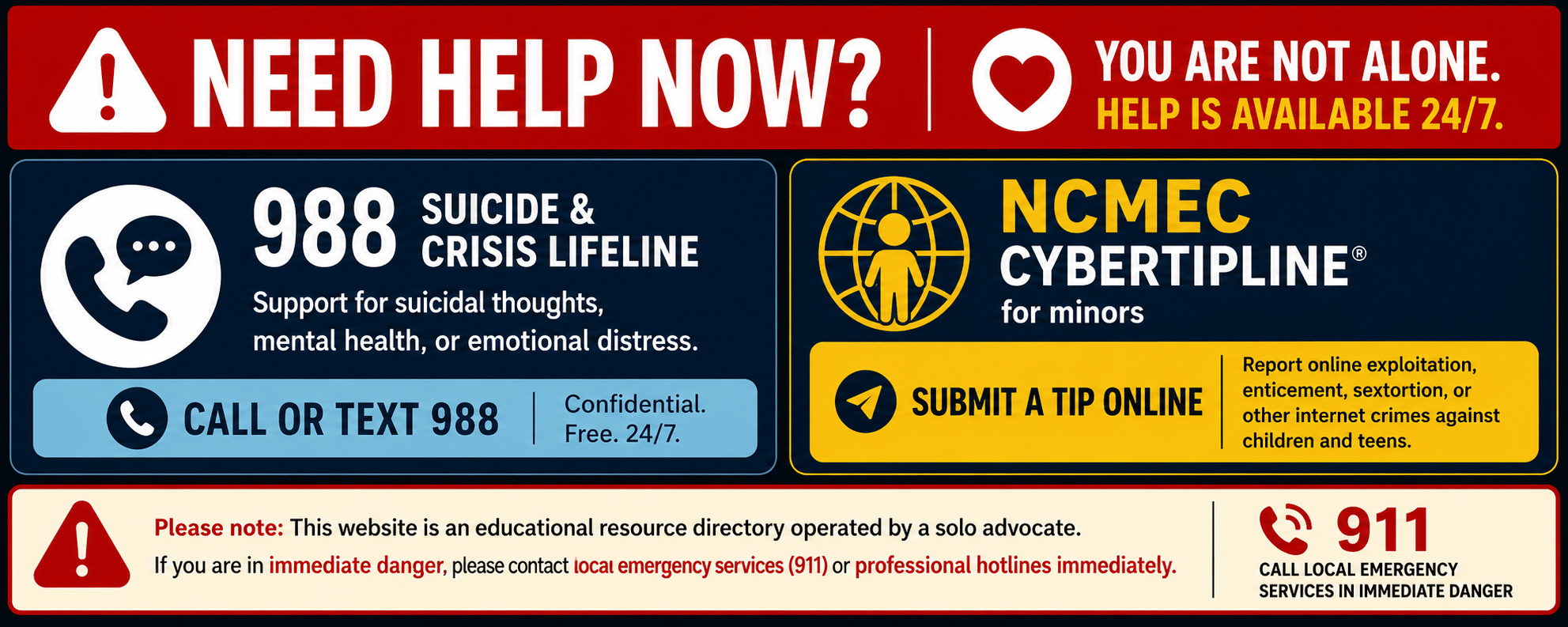
- National Center for Missing & Exploited Children (NCMEC) – CyberTipline: The premier resource for reporting cases involving individuals under 18. Reports can be made at report.cybertip.org or 1-800-THE-LOST.
- Homeland Security Investigations (HSI): Specifically for reporting child exploitation and sexual abuse, they can be reached at 1-866-DHS-2-ICE.
- RAINN (Rape, Abuse & Incest National Network): Operates the National Sexual Assault Hotline for confidential support. 800-656-HOPE or online.rainn.org.



Resource Links
© 2026 Luke Bowlin. All rights reserved.